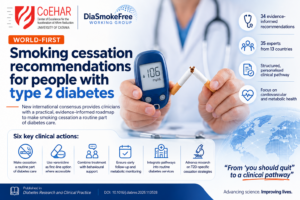

For people living with diabetes, smoking represents much more than a harmful habit — it is a major driver of cardiovascular complications and long-term metabolic damage. Quitting is one of the most powerful actions to improve health outcomes. Yet, in clinical practice, stopping smoking in this population is often far from straightforward.
People with diabetes who smoke face a dual challenge: while cessation brings clear benefits, it can also be accompanied by weight gain, fluctuations in blood glucose, and significant psychological barriers. These factors can make quitting harder to sustain and relapse more likely compared with the general population.
A new expert review by CoEHAR, published in the World Journal of Diabetes, explores why smoking cessation in diabetes requires a more tailored and pragmatic approach — one that is fully integrated into routine diabetes care rather than treated as a separate issue.
A personalized roadmap for quitting
The authors argue that clinicians should move beyond “one-size-fits-all” cessation advice and instead provide long-term, individualized support. Evidence-based pharmacotherapies remain essential, with varenicline emerging as the treatment with the strongest supporting data for smokers with diabetes, while nicotine replacement therapy and bupropion may also offer benefits despite limited diabetes-specific research.
Just as importantly, the review stresses that quitting is not the end of the process, but the beginning of a new phase that requires careful medical follow-up. Early monitoring of glucose control, body weight, and blood pressure is crucial, as metabolic changes after cessation may require adjustments in diabetes management.
When quitting is not immediately achievable
Recognizing the realities of relapse and repeated quit failures, CoEHAR experts also highlight the potential role of tobacco harm reduction strategies. For people who are not ready to quit or who repeatedly struggle with cessation, switching away from combustible cigarettes — for example to e-cigarettes, heated tobacco products, or oral nicotine products — may significantly reduce exposure to toxicants while supporting a gradual transition away from smoking.
Emerging tools and future directions
The review also points to promising new supports, including GLP-1 receptor agonists, which may help address appetite and weight concerns after quitting, and digital innovations such as apps, wearables, and remote carbon monoxide monitoring to improve adherence and provide real-time assistance.
A practical resource for healthcare professionals
To help translate evidence into practice, the paper includes a simple clinical algorithm designed specifically for diabetes care. It guides clinicians through key decision points: readiness to quit, weight-management concerns, and harm-reduction pathways when cessation cannot be achieved immediately.
This expert review reinforces a clear message: smoking cessation in diabetes is essential, but it must be approached with flexibility, personalization, and realistic alternatives — ensuring that no patient is left without support.
Reference
Russo C, Walicka M, Cohen G, Bellanca CM, Geraci G, Caponnetto P, Noviello DE, Chianetta R, George J, Sammut R, Franek E, Polosa R.
Addressing the dual challenge: Managing smoking cessation in patients with diabetes.
World Journal of Diabetes 2025; 16(12):105241.
DOI: 10.4239/wjd.v16.i12.105241
Full text: https://www.wjgnet.com/1948-9358/full/v16/i12/105241.htm