Oral cancer remains one of the most preventable yet persistent global health challenges. Tobacco smoking continues to be its most consistent and powerful risk factor, driven by decades of exposure to combustion-derived carcinogens that promote DNA damage, chronic inflammation and malignant transformation.
In this evolving nicotine landscape, a new CoEHAR Review published in Frontiers in Oral Health examines a pressing question: how should nicotine pouches be positioned within oral cancer prevention strategies?
The authors argue that the discussion must start from a clear premise: combustion is the primary driver of oral carcinogenesis. Traditional cigarettes expose users to thousands of toxic compounds, including dozens of established carcinogens. In contrast, nicotine pouches eliminate combustion and tobacco leaf, and toxicological analyses consistently show substantially lower levels of harmful constituents compared with cigarettes and high-nitrosamine smokeless tobacco products.
But lower toxicant exposure does not automatically translate into long-term cancer risk reduction — and this is where the evidence gap becomes central.
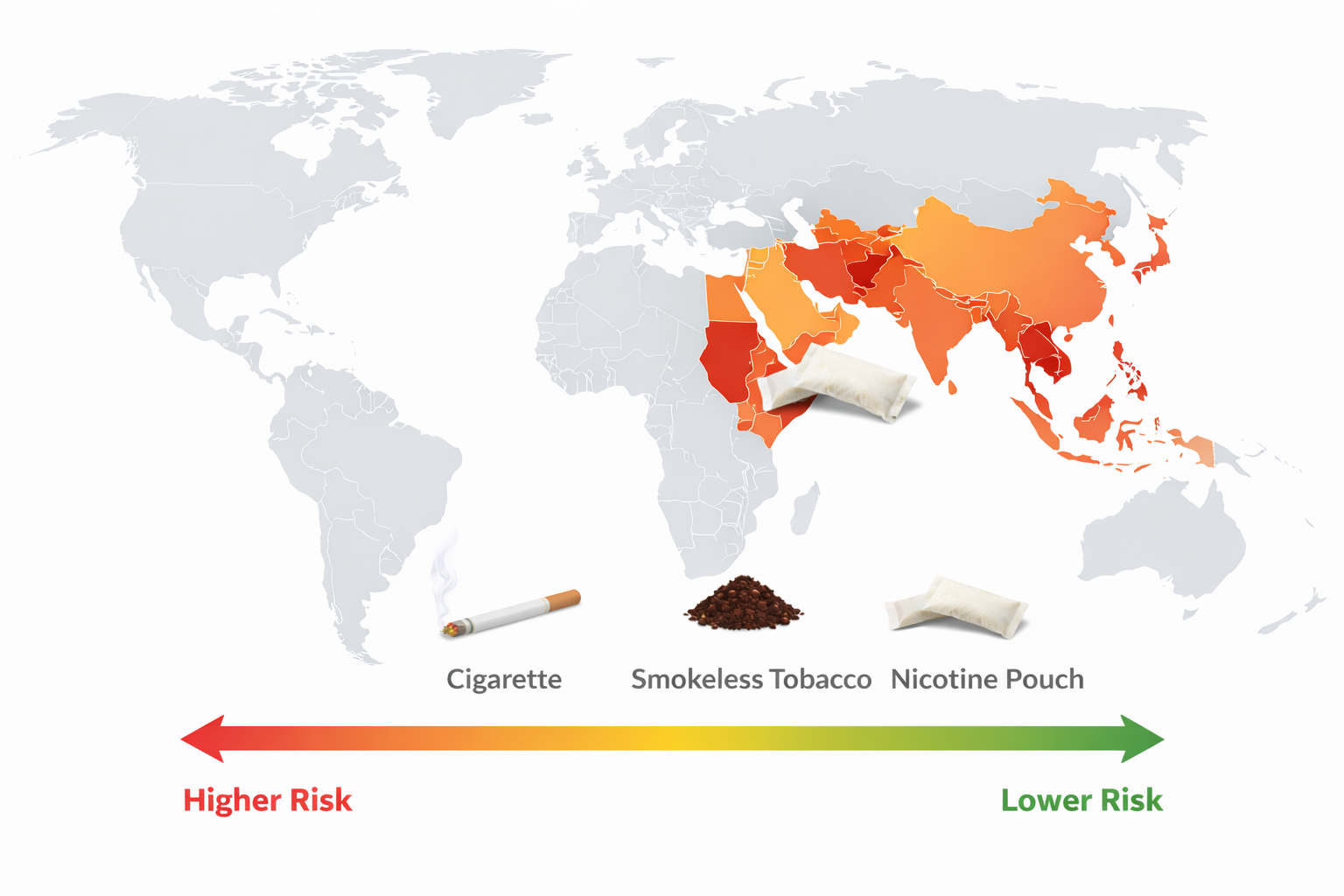
A risk continuum, not a binary debate
The review places nicotine pouches within a broader risk continuum. Historical and epidemiological data from Sweden — where snus has largely replaced smoking — suggest that shifting away from combustible tobacco can coincide with lower tobacco-attributable mortality and no detectable increase in oral cancer risk at the population level.
Nicotine pouches differ from snus in composition and regulatory classification, yet they share a key feature: the absence of combustion.
Short-term human studies reviewed in the paper report improvements in gingival inflammation and reductions in pre-existing snus-associated mucosal lesions among switchers. However, the authors caution that oral cancer develops over long latency periods. Products that have been on the market for less than a decade cannot yet be evaluated using the epidemiological standards applied to cigarettes.
The real research challenge
Rather than offering premature conclusions, the authors frame the issue as a research priority. They call for long-term prospective cohort studies, independent toxicological assessments, standardized product testing and surveillance of dual use and youth uptake. Importantly, much of the available toxicological evidence comes from industry-funded studies, reinforcing the need for independent validation.
“Smoking remains the primary cause of oral cancer worldwide. If we remove combustion, we remove the main source of carcinogenic exposure — but we must evaluate new products with scientific rigor, long-term data, and transparent surveillance,” said Prof. Riccardo Polosa, co-author of the review and founder of CoEHAR. “Harm reduction is not about declaring products safe; it is about understanding relative risk and providing evidence-based alternatives for adults who would otherwise continue to smoke.”
The paper does not present nicotine pouches as risk-free. Instead, it situates them within a pragmatic harm reduction framework: for adults who smoke — particularly in regions where high-nitrosamine smokeless tobacco and areca nut use continue to drive oral cancer burden — eliminating combustion may substantially reduce carcinogen exposure. This potential must be balanced against regulatory oversight, transparent communication of relative risk, and continuous surveillance.
In a field often polarized between alarmism and uncritical endorsement, this Review advocates for something more rigorous: evidence-led evaluation grounded in long-term data.
About the article
La Rosa GRM, Samaranayake LP, Zaura E, Chapple I, Polosa R.
Nicotine pouches, oral cancer and tobacco harm reduction: current evidence and research priorities.
Frontiers in Oral Health (2026); 7:1761734.
DOI: 10.3389/froh.2026.1761734