
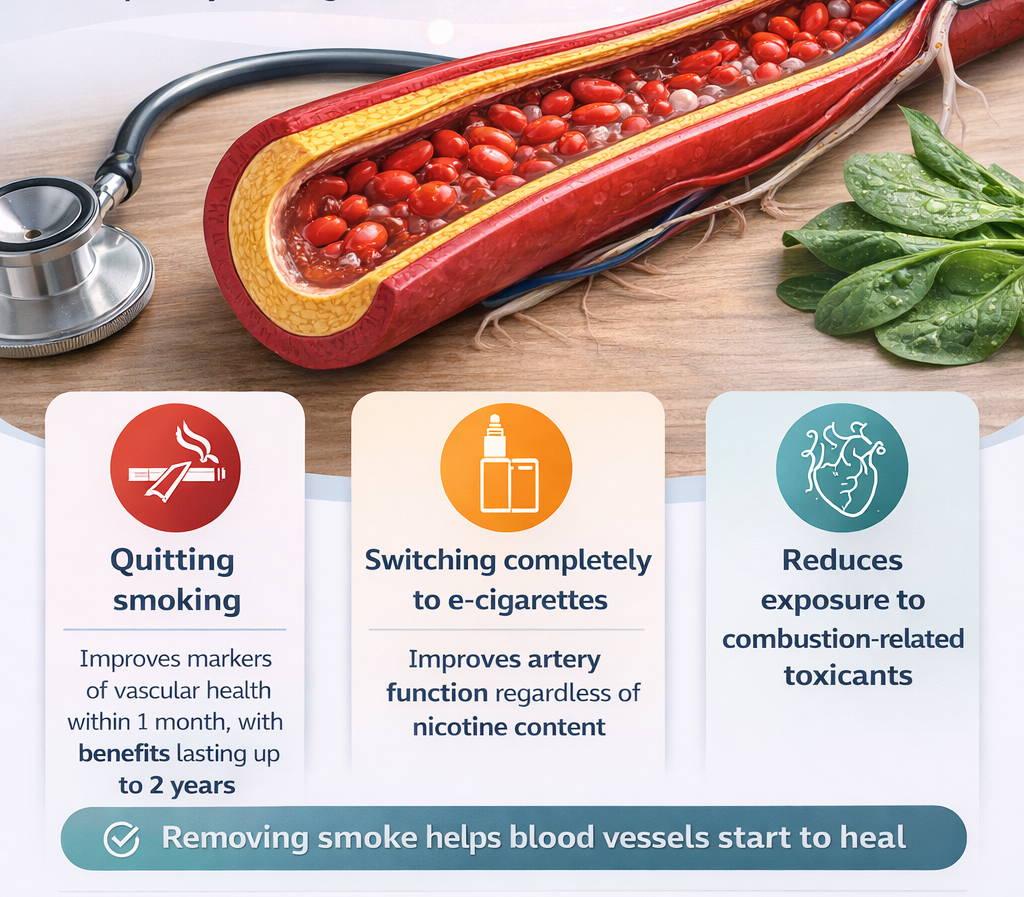
The damage caused by smoking does not start with a heart attack. It begins much earlier, at the level of the blood vessels. When someone smokes, the chemicals produced by combustion make arteries stiffer and impair the inner lining of blood vessels (the endothelium), reducing their ability to dilate properly. These early changes increase long-term cardiovascular risk — often years before clinical disease becomes visible.
A new CoEHAR systematic review, published in the European Journal of Preventive Cardiology, examined 23 prospective clinical studies involving 11,702 participants to understand what happens to vascular health after quitting smoking or switching completely to e-cigarettes.
What happens after quitting?
Across studies, smoking cessation was associated with measurable improvements in:
- Arterial stiffness (how rigid the arteries are)
- Wave reflection in the arteries (a marker of vascular load)
- Endothelial function, meaning the ability of blood vessels to relax and respond properly
Some improvements were detectable within one month of quitting and were maintained for up to two years in longer follow-ups. These markers are important because they can detect early cardiovascular recovery long before heart attacks or strokes occur.
What about switching to e-cigarettes?
The review also evaluated randomized studies in which smokers switched completely to e-cigarettes. In these trials, improvement in endothelial function was observed regardless of whether the e-cigarette contained nicotine. This finding suggests that the main driver of vascular damage in smokers is not nicotine itself, but exposure to combustion-related toxic chemicals.
Evidence still evolving
The authors assessed the quality of the evidence using the GRADE framework. Overall, the certainty of evidence was rated as low for many of the vascular outcomes analyzed, mainly due to methodological differences across studies.
However, randomized controlled trials assessing endothelial function showed moderate certainty of evidence, with consistent findings indicating improvements in vascular function following smoking cessation or complete switching to e-cigarettes.
Cardiovascular disease remains the leading cause of death among people who smoke. Demonstrating early improvements in vascular function provides biological evidence that stopping exposure to combustible tobacco — and potentially switching completely away from combustion — can reverse some of the damage.
“We often focus on long-term outcomes like heart attacks or strokes, but the recovery process begins much earlier — at the level of the blood vessels,” said Prof. Riccardo Polosa, founder of CoEHAR and co-author of the review. “When combustion stops, vascular function starts to improve. These measurable changes show that removing exposure to smoke has immediate biological benefits. This is a powerful message for patients and clinicians alike.”
About the article
George J, La Rosa GRM, Yu J, Capodanno D, Geraci G, Ohki T, Sequeira R, Polosa R.
Vascular Health After Quitting Smoking or Switching to E-Cigarette Use: A Systematic Review of Prospective Studies with GRADE Assessment.
European Journal of Preventive Cardiology. 2026; zwag123.
DOI: 10.1093/eurjpc/zwag123