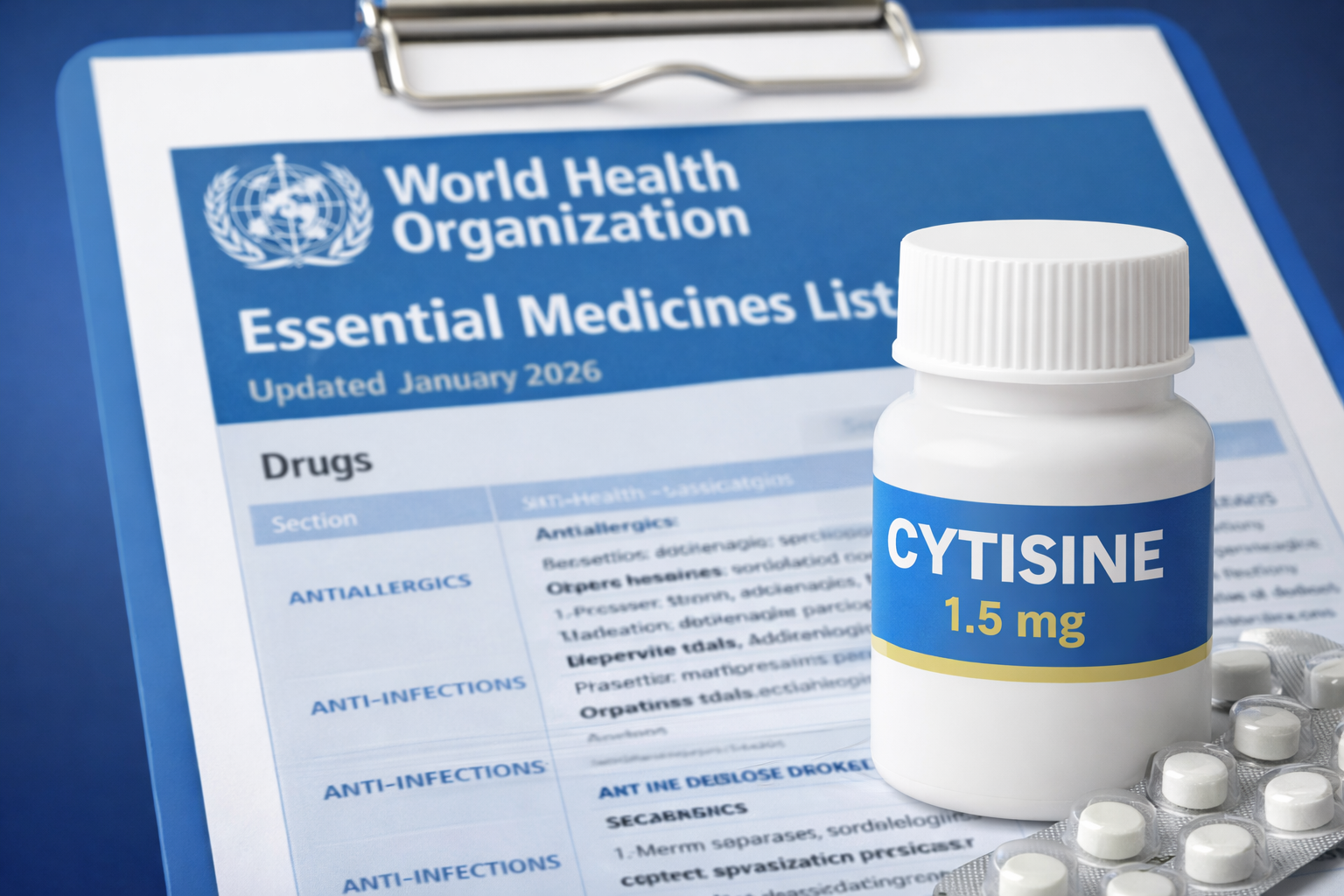
The World Health Organization (WHO) has added cytisine to its Model List of Essential Medicines (EML), marking a major milestone for global tobacco control and smoking cessation. The decision formally recognizes cytisine as a safe, effective, and affordable medicine to help people quit smoking — and could significantly expand access worldwide.
Cytisine has been supported by scientific evidence for decades, yet its uptake has remained limited, particularly outside parts of Central and Eastern Europe. WHO’s inclusion of the drug on the Essential Medicines List signals a shift that may finally bring cytisine into routine clinical practice at a global scale.
Why this decision matters
In a new iScience Perspective, CoEHAR founder Riccardo Polosa and Gal Cohen argue that WHO’s decision should act as a catalyst for rapid country-level adoption, especially in low- and middle-income countries, where access to smoking-cessation therapies remains highly uneven.
Recent meta-analyses show that cytisine increases the likelihood of smoking cessation by approximately 2.6-fold compared with placebo, with efficacy comparable to varenicline and a favorable tolerability profile. Importantly, cytisine stands out for its low cost: in Italy, traditional galenic formulations can cost around €30–35 for a full one-month course, making it far more affordable than many existing pharmacotherapies.
A long-overdue correction
The authors frame WHO’s move as a long-overdue correction to decades of underuse driven not by lack of evidence, but by limited commercial incentives and regulatory inertia. With Essential Medicines List status, cytisine is now positioned to benefit from public procurement mechanisms, generic production, and inclusion in national formularies — steps that could dramatically reduce disparities in access to smoking-cessation treatment.
“It has taken almost half a century for a proven, life-saving smoking-cessation medicine to be recognized on the WHO Essential Medicines List. This decision can accelerate access to an effective, affordable option at population scale.”
— Riccardo Polosa, MD, PhD (University of Catania / CoEHAR)
“Essential Medicines List designation can shift cytisine from ‘known in the literature’ to ‘available in practice’, supporting national formulary decisions, procurement pathways, and broader access where the burden of tobacco-related disease is greatest.”
— Gal Cohen, PhD (Rose Research Center)
By elevating cytisine to Essential Medicines status, WHO has sent a clear signal: effective smoking-cessation treatment should not be a luxury, but a core component of public health systems worldwide. If rapidly adopted, cytisine could play a critical role in reducing the global burden of tobacco-related disease, particularly in settings where existing therapies are unavailable or unaffordable.
About the article
Polosa R, Cohen G.
Rediscovering cytisine: Why the WHO’s decision matters for global public health.
iScience (2026).
DOI: 10.1016/j.isci.2026.114874
https://doi.org/10.1016/j.isci.2026.114874