
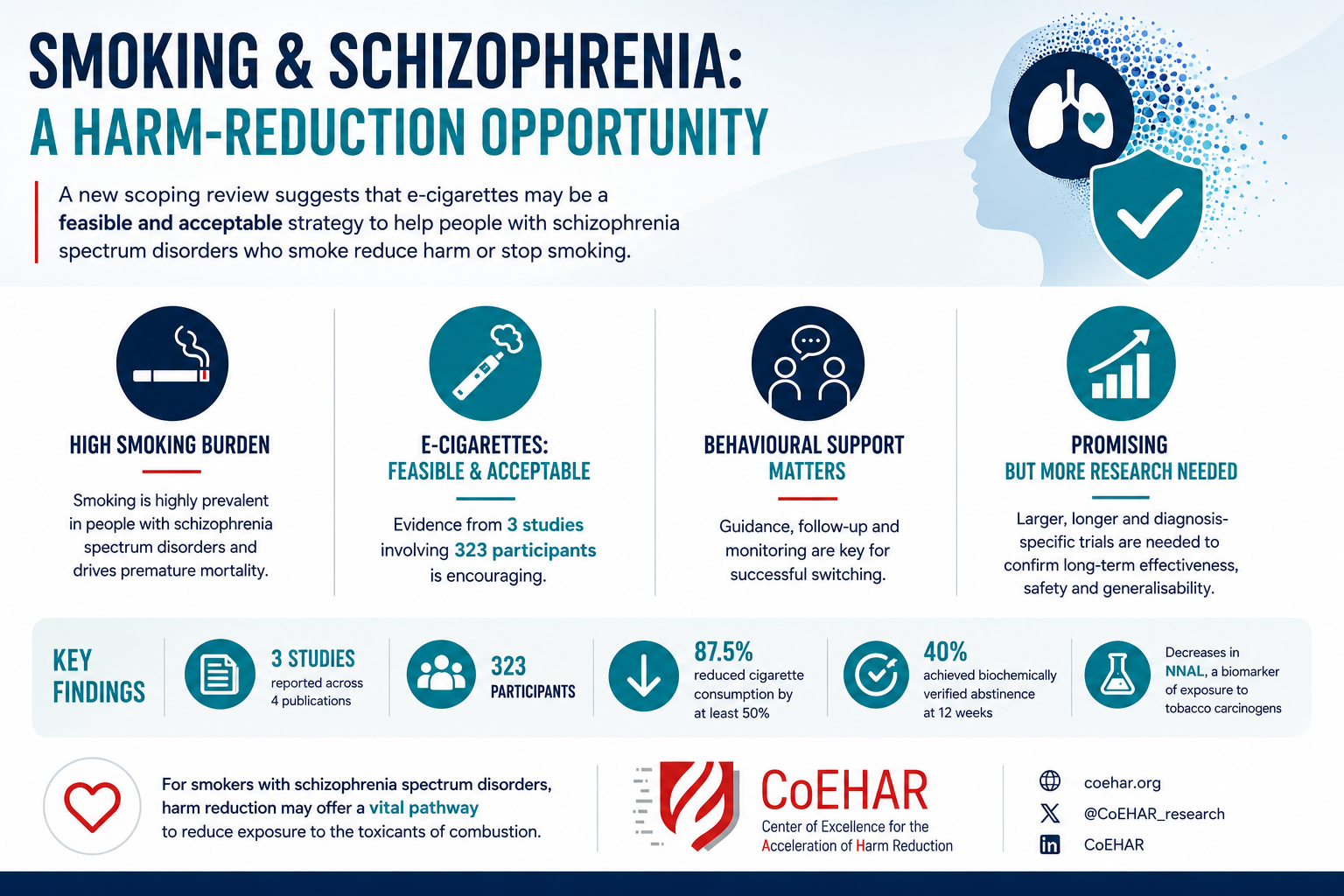
Smoking remains a major and often overlooked health burden among people with schizophrenia spectrum disorders. A new scoping review published in Frontiers in Psychiatry suggests that e-cigarettes may represent a feasible and acceptable harm-reduction option for smokers in this particularly vulnerable population, although larger and longer-term studies are still needed.
The review, authored by an international team of researchers including scientists from CoEHAR, examined the latest evidence on the use of e-cigarettes among people with schizophrenia spectrum disorders who smoke.
Smoking prevalence remains exceptionally high in this population and contributes substantially to premature mortality from cardiovascular disease, cancer and respiratory illness. At the same time, conventional smoking-cessation interventions often achieve poorer outcomes than those observed in the general population, highlighting the need for more tailored and pragmatic approaches.
Encouraging Results from Early Studies
The researchers identified three studies, reported across four publications, involving a total of 323 participants.
Although the evidence base remains limited, the available findings were encouraging. E-cigarette-based interventions were generally found to be feasible, acceptable and well tolerated, with preliminary evidence suggesting reductions in cigarette consumption, short-term smoking abstinence and lower exposure to tobacco-related toxicants.
In one study specifically involving people with schizophrenia spectrum disorders, 87.5% of participants reduced their cigarette consumption by at least 50%, while 40% achieved biochemically verified smoking abstinence at 12 weeks.
Other studies involving broader populations with serious mental illness also reported reductions in cigarette consumption and short-term decreases in NNAL, a biomarker of exposure to tobacco-specific carcinogens.
Switching Requires More Than Providing an E-Cigarette
The review also highlights an important point: simply providing an e-cigarette may not be sufficient to achieve sustained harm reduction. Better outcomes may be achieved when switching is accompanied by behavioural support, regular follow-up and monitoring, particularly in a population with complex clinical needs.
This support is also important to encourage complete substitution of combustible cigarettes and avoid prolonged dual use, which may limit the potential health benefits of switching away from tobacco combustion.
A Harm-Reduction Opportunity for a Vulnerable Population
People with schizophrenia spectrum disorders have historically experienced substantial health inequalities, including a disproportionate burden of smoking-related disease. For smokers who are unable to quit using conventional approaches, the authors suggest that tobacco harm reduction could provide an additional pathway to reduce exposure to the toxic substances generated by cigarette combustion.
However, the researchers stress that the current evidence remains preliminary. Larger, longer and diagnosis-specific clinical trials are needed to establish the long-term effectiveness, safety and generalisability of e-cigarette-based interventions in people with schizophrenia spectrum disorders.
The review therefore points toward a promising research direction rather than a definitive clinical recommendation: smoking cessation remains the preferred outcome, while harm-reduction strategies may offer another opportunity to support smokers who would otherwise continue smoking.
Reference
Caponnetto P, Pratt S, Bellanca CM, et al. Latest developments in the use of e-cigarettes by people with schizophrenia spectrum disorders who smoke: a scoping review. Frontiers in Psychiatry. 2026;17:1811946. doi: 10.3389/fpsyt.2026.1811946.
https://www.frontiersin.org/journals/psychiatry/articles/10.3389/fpsyt.2026.1811946/full