
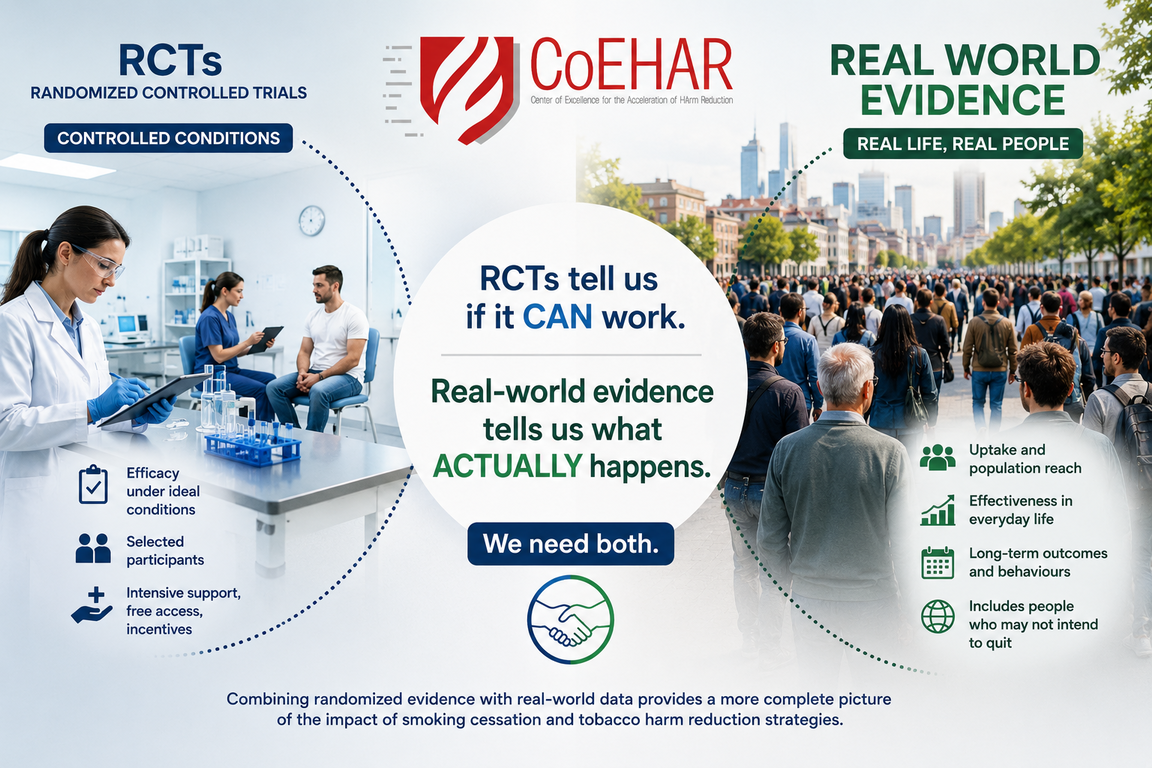
Randomized controlled trials remain the gold standard for evaluating the efficacy of smoking cessation interventions, but they cannot answer every question. A new commentary published in Harm Reduction Journal argues that real-world evidence should play a greater role in understanding how tobacco harm reduction strategies perform outside controlled research settings.
The commentary examines how real-world data (RWD) can complement randomized controlled trials (RCTs) and provide a more complete picture of the population impact of smoking cessation and tobacco harm reduction interventions.
RCTs are essential for establishing whether an intervention can work under controlled conditions. However, participants enrolled in clinical trials are often too much highly selected and may receive intensive behavioural support, free access to treatments or products, frequent follow-up and, in some cases, monetary incentives. These conditions are valuable for determining efficacy, but they do not always reflect how people behave, access products or attempt to quit smoking in everyday life.
From efficacy to real-world impact
Real-world evidence can help address some of these gaps. Data from longitudinal cohorts, population surveys, electronic health records, retail data and post-market surveillance can provide valuable information about how smoking cessation and harm reduction strategies are actually adopted and used over time.
Such evidence can help researchers investigate uptake, effectiveness, consumer behaviour and longer-term outcomes, while also capturing groups of smokers who may be underrepresented in conventional clinical trials.
This distinction is particularly relevant in tobacco harm reduction, where many smokers may adopt non-combustible nicotine products outside formal cessation programmes and without initially intending to quit smoking.
Effectiveness is not enough: reach matters
One of the central messages of the commentary is that the potential public-health impact of an intervention depends not only on its efficacy, but also on its reach. A cessation intervention may perform extremely well in a randomized trial but have limited population impact if relatively few smokers are willing or able to use it.
Conversely, non-combustible nicotine products such as e-cigarettes may reach smokers who would never enrol in a conventional cessation programme, potentially creating additional pathways away from combustible cigarettes.
“RCTs tell us whether an intervention can work; real-world evidence helps us understand whether it actually works at population level, for whom, and under what conditions,” said senior author Professor Riccardo Polosa.
This broader perspective can therefore help researchers and policymakers move beyond the question of whether an intervention works under ideal conditions and consider what happens when it becomes available to a much larger and more diverse population.
RWE should complement, not replace, randomized trials
The authors also caution against interpreting real-world evidence as an alternative to rigorous randomized research. Observational data can be affected by important methodological limitations, including confounding and selection bias, making causal interpretation more challenging.
For this reason, the authors argue for evidence integration rather than evidence hierarchy: RCTs and real-world studies answer different but complementary questions. Combining randomized evidence with high-quality real-world data can provide clinicians, researchers and regulators with a more realistic understanding of the effectiveness, reach and population impact of smoking cessation and tobacco harm reduction strategies.
Reference
Selya A, Le G, Tomaselli V, Polosa R. Bridging evidence gaps: the role of real-world data in tobacco harm reduction. Harm Reduct J. 2026 Aug 25;23(1):140. doi: 10.1186/s12954-026-01511-0. PMID: 42642768.
https://link.springer.com/article/10.1186/s12954-026-01511-0