Emergency Departments (EDs) could play a much greater role in helping smokers quit, turning an acute health event into an opportunity to initiate smoking cessation.
This is the central message of a new CoEHAR review, published in Internal and Emergency Medicine. “Smoking cessation in emergency departments: a reality check” examines current clinical evidence and proposes a pragmatic approach for integrating smoking cessation into routine emergency care.
A powerful “teachable moment”
Patients arriving at an ED with conditions such as myocardial infarction, stroke, pneumonia or COPD exacerbations may be particularly receptive to quitting. At that moment, the consequences of smoking become immediate and tangible.
Evidence suggests, however, that advice alone is often insufficient. More promising approaches combine brief counselling with immediate therapeutic support—including nicotine replacement therapy, pharmacotherapy or, where appropriate, an e-cigarette starter kit—and structured follow-up after discharge.
The UK CoSTED trial, highlighted in the review, provides an example: smokers receiving brief advice, an e-cigarette starter kit and referral support achieved 7.2% biochemically verified abstinence at six months, compared with 4.1% among those receiving written information alone.
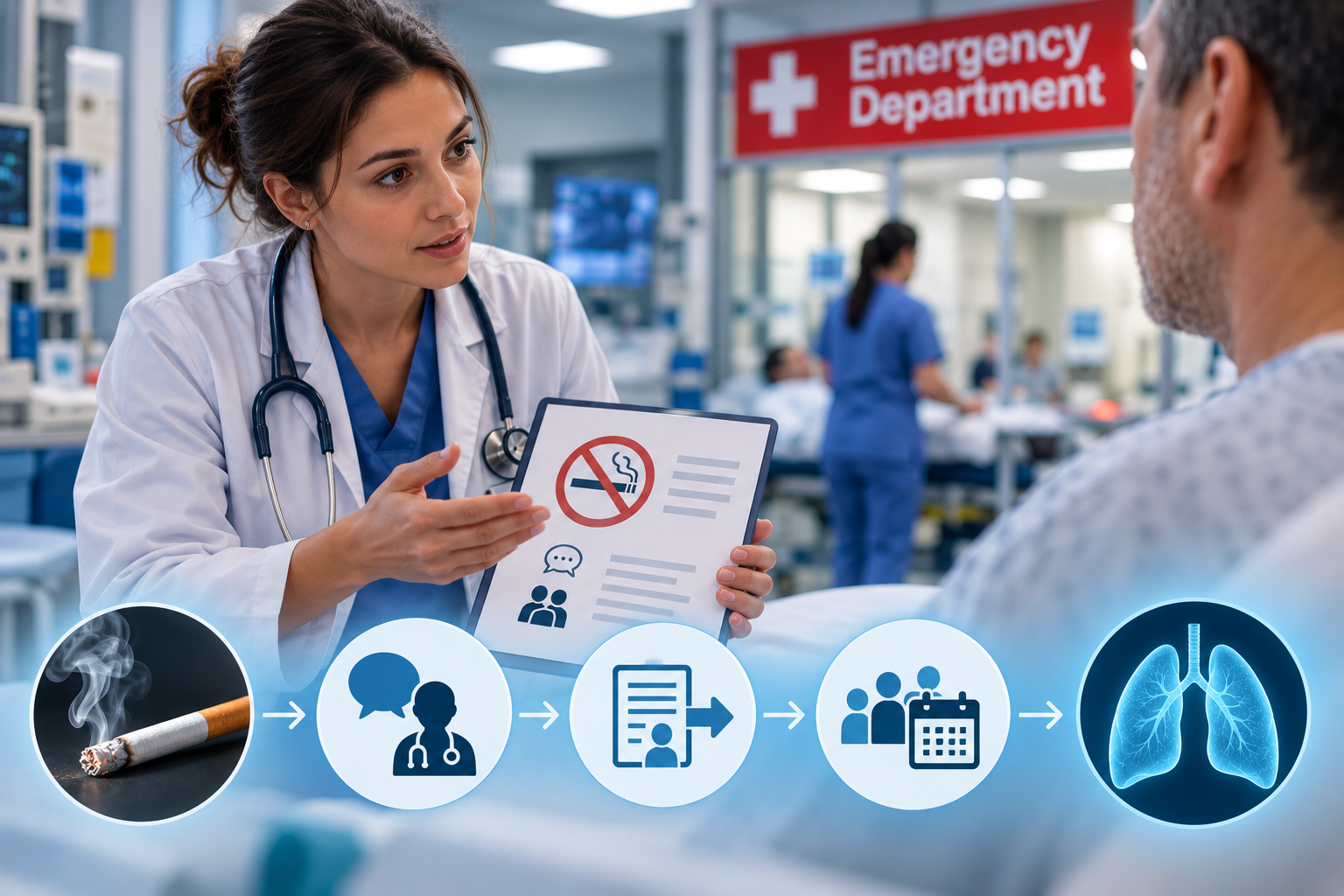
The authors therefore propose a simple pathway that can begin at triage: identify smoking or nicotine use, provide a very brief intervention and appropriate treatment, and arrange follow-up before discharge.
“We should not expect Emergency Departments to deliver an entire smoking cessation programme. Their role should be to open the door to cessation: identify tobacco and nicotine use, provide an appropriate brief intervention and treatment, and connect the patient with continued support after discharge. In emergency care, even a few minutes can be enough to start a pathway that may help prevent the next smoking-related emergency,” said Dr Davide Campagna, Researcher in Internal Medicine at the University of Catania and Emergency Medicine Physician at the University Hospital of Catania.
This approach reflects a key principle of the paper: an ED intervention should take minutes, not half an hour, while longer-term cessation support should continue beyond the emergency setting.
From evidence to routine care
For the authors, the greatest challenge is implementation. Overcrowded EDs and competing clinical priorities make it difficult to provide cessation support consistently unless it is built into existing workflows.
Dedicated resources, automated pathways, referral systems, performance measures and appropriate reimbursement could help turn an effective intervention into routine clinical practice.
“The Emergency Department should not be only the place where we treat the consequences of smoking—it can also be where we start preventing the next heart attack, stroke or respiratory crisis. But a teachable moment without an implementation incentive is simply a missed opportunity. If cessation is not built into ED workflow, funded, measured and rewarded, it will remain a good idea rather than routine care” said Prof. Riccardo Polosa, founder of CoEHAR.
The authors now call for pragmatic multicentre studies assessing not only quit rates, but also feasibility, staff workload, patient reach, continuity of care, equity, cost-effectiveness and relapse.
The message is straightforward: Emergency Departments already treat the consequences of smoking every day. With a brief, structured intervention and effective follow-up, they could also help prevent the next smoking-related emergency.
Reference
Campagna D, Cucuzza F, Russo C, Putra JA, Caponnetto P, La Rosa GRM, Prosperini U, Agrawal S, Polosa R. Smoking cessation in emergency departments: a reality check. Internal and Emergency Medicine. 2026 Sep 24. doi: 10.1007/s11739-026-04528-2.
https://link.springer.com/article/10.1007/s11739-026-04528-2