New international consensus addresses a long-standing gap in diabetes care with practical, evidence-informed guidance for clinicians
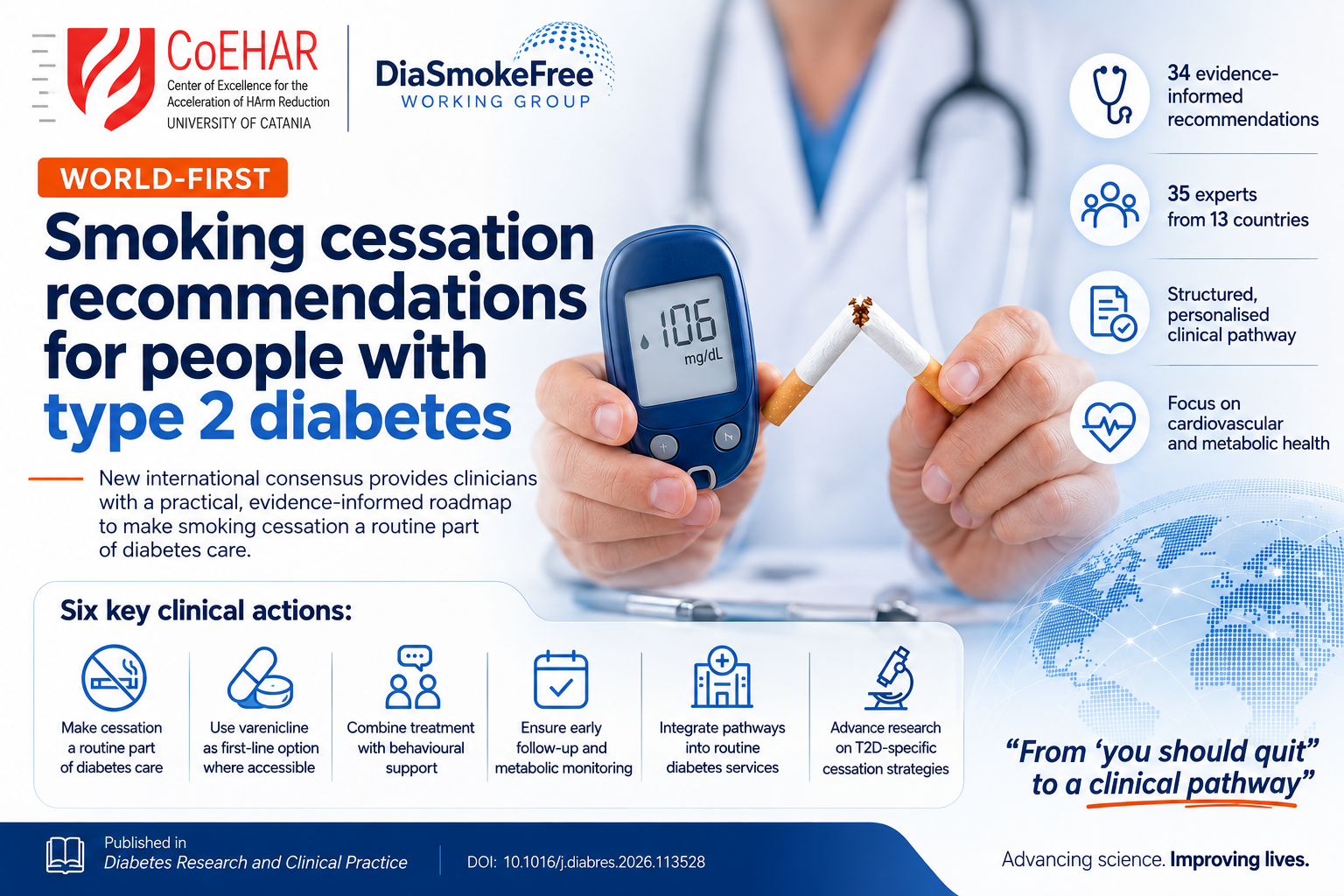
An international panel of 35 experts from 13 countries has published the world’s first dedicated international consensus recommendations for smoking cessation in people with type 2 diabetes (T2D).
Published in Diabetes Research and Clinical Practice, the recommendations were developed through the DiaSmokeFree Working Group, an international initiative conceived and coordinated by the Center of Excellence for the Acceleration of Harm Reduction (CoEHAR) at the University of Catania.
The new consensus addresses a long-standing gap in diabetes care. Smoking increases the risk of complications in people with T2D, while quitting can substantially reduce cardiovascular and other health risks. Yet smoking cessation in this population requires specific clinical attention, including monitoring of glycaemic control, body weight, blood pressure and potential changes in the metabolism of some medications.
Rather than simply advising patients to quit, the recommendations provide healthcare professionals with a structured and personalised clinical pathway for supporting smoking cessation safely and effectively.
34 recommendations for clinical practice
The DiaSmokeFree initiative began in 2022, when CoEHAR identified the need for smoking cessation guidance specifically tailored to people living with type 2 diabetes and brought together an international multidisciplinary group of experts.
Using a structured consensus process, including the GRADE approach where feasible and the AGREE framework, the Working Group developed 34 evidence-informed recommendations, summarised into six overarching clinical actions.
The consensus calls on healthcare professionals to:
- make smoking cessation a routine and essential component of T2D care;
- use varenicline as first-line pharmacotherapy where accessible, with nicotine replacement therapy or bupropion as alternatives when appropriate;
- combine pharmacotherapy with structured, intensive behavioural support;
- arrange early follow-up, ideally within two weeks and again at four weeks, to monitor glycaemic control, weight, blood pressure and possible drug–smoke interactions;
- integrate smoking cessation pathways into routine diabetes services through referrals, electronic prompts and multidisciplinary coordination;
- strengthen research into T2D-specific cessation strategies, including emerging pharmacotherapies, electronic cigarettes and digital support platforms.
Among currently available smoking cessation medications, varenicline was the only treatment supported by sufficient evidence for a strong recommendation in this population. The experts also emphasise that behavioural support should be considered an integral part of treatment.
From “you should quit” to a clinical pathway
“We are immensely proud of this pioneering achievement. For the first time, clinicians have comprehensive, actionable guidance designed specifically for a high-risk population that has been overlooked for too long,” said Professor Riccardo Polosa, who conceived and coordinated the initiative. “This turns a familiar instruction, ‘you should quit’, into a practical clinical pathway for helping patients with diabetes quit safely and successfully.”
Professor Magdalena Walicka, first author of the consensus, highlighted the need for diabetes-specific cessation support, noting that people with T2D face a high burden of preventable complications while cessation interventions are rarely tailored to their specific clinical needs. The recommendations bring treatment, metabolic monitoring and relapse prevention together within a single framework.
The next step: implementation
The publication marks the first major scientific milestone of the broader DiaSmokeFree initiative.
CoEHAR is now working to translate the international consensus into practical resources and implementation pathways for healthcare professionals, diabetes clinics and health systems, with dedicated clinical and educational materials currently under development.
“CoEHAR recognised this neglected need and convened an outstanding international group to address it,” said Professor Giovanni Li Volti, Director of CoEHAR. “The result is more than a consensus paper: it is a blueprint for making smoking cessation part of routine diabetes care worldwide. Our next task is to translate these recommendations into practical tools and care pathways that clinicians can use—and into measurable improvements for patients.”
The DiaSmokeFree Working Group brings together 35 experts from 13 countries across five continents, with expertise spanning diabetes, smoking cessation, cardiovascular medicine, pharmacology, behavioural science and public health.
Read the publication
Walicka M, Russo C, Ceriello A, George J, Campagna D, Misra A, La Rosa GRM, Sammut R, Polosa R, DiaSmokeFree Working Group.
International consensus recommendations for smoking cessation in type 2 diabetes from the DiaSmokeFree Working Group.
Diabetes Research and Clinical Practice. 2026.
DOI: 10.1016/j.diabres.2026.113528
https://www.sciencedirect.com/science/article/pii/S0168822726004481?via%3Dihub
Media resources
Press Release
CoEHAR-led initiative publishes world-first smoking cessation recommendations for people with type 2 diabetes
→ Download the Press Release (PDF)