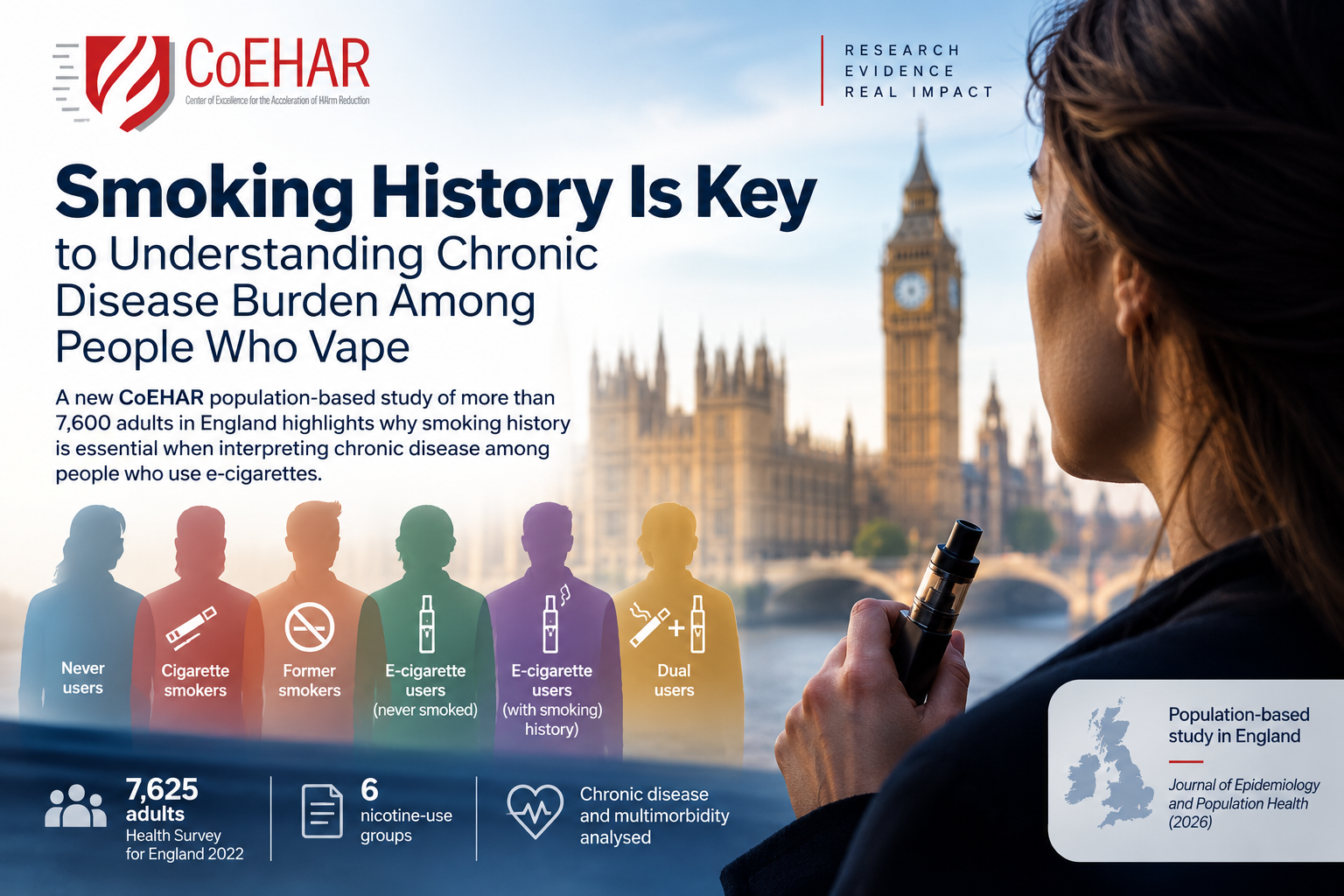
A new CoEHAR population-based study of more than 7,600 adults in England highlights why smoking history is essential when interpreting chronic disease among people who use e-cigarettes.
Published in the Journal of Epidemiology and Population Health, the study analysed data from 7,625 adults participating in the 2022 Health Survey for England. Researchers compared chronic disease and multimorbidity across six groups, importantly distinguishing e-cigarette users who had never smoked from those who had previously smoked cigarettes.
Smoking history makes a difference
Higher overall morbidity and multimorbidity were observed among current smokers, former smokers, dual users and e-cigarette users with a previous smoking history.
In contrast, e-cigarette users who had never smoked showed no clear evidence of increased overall morbidity or multimorbidity after adjustment. However, this subgroup included only 44 participants, most of them young, so the authors stress that the finding should not be interpreted as evidence that vaping is harmless.
The distinction matters because many people who currently vape are former smokers. Their health profile may therefore reflect years of previous exposure to combustible cigarettes, as well as the possibility that some people quit or switch products after developing health problems.
Not all vapers have the same exposure history
The study highlights a key methodological issue in e-cigarette research: people who vape should not be treated as a single population.
A never-smoker who vapes and a former smoker who has switched completely to e-cigarettes have fundamentally different exposure histories. Failing to account for this difference can make it difficult to determine how much of the observed disease burden is related to previous smoking.
The same caution applies to dual use. Continued cigarette smoking maintains exposure to combustible tobacco, which is why the authors stress that quitting smoking or switching completely away from cigarettes remains preferable to continued dual use.
Because the study is cross-sectional, it cannot establish causality or determine whether nicotine-product use preceded disease. Larger longitudinal studies with more detailed lifetime exposure histories are needed. However, the key message is simple: when assessing the health of people who vape, what they smoked before may be just as important as what they use today.
Read the publication:
Adebisi YA, Cantone G, Bafail DA, Ogunkola IO, Tomaselli V, Shukri AK, Alshahrani NZ, Lucero-Prisno DE 3rd, Polosa R. Heterogeneous associations between cigarette and e-cigarette use patterns and chronic disease burden: A population-based study. Journal of Epidemiology and Population Health. 2026;74(6):203800. doi: 10.1016/j.jeph.2026.203800
https://www.sciencedirect.com/science/article/pii/S2950433326006348?via%3Dihub