
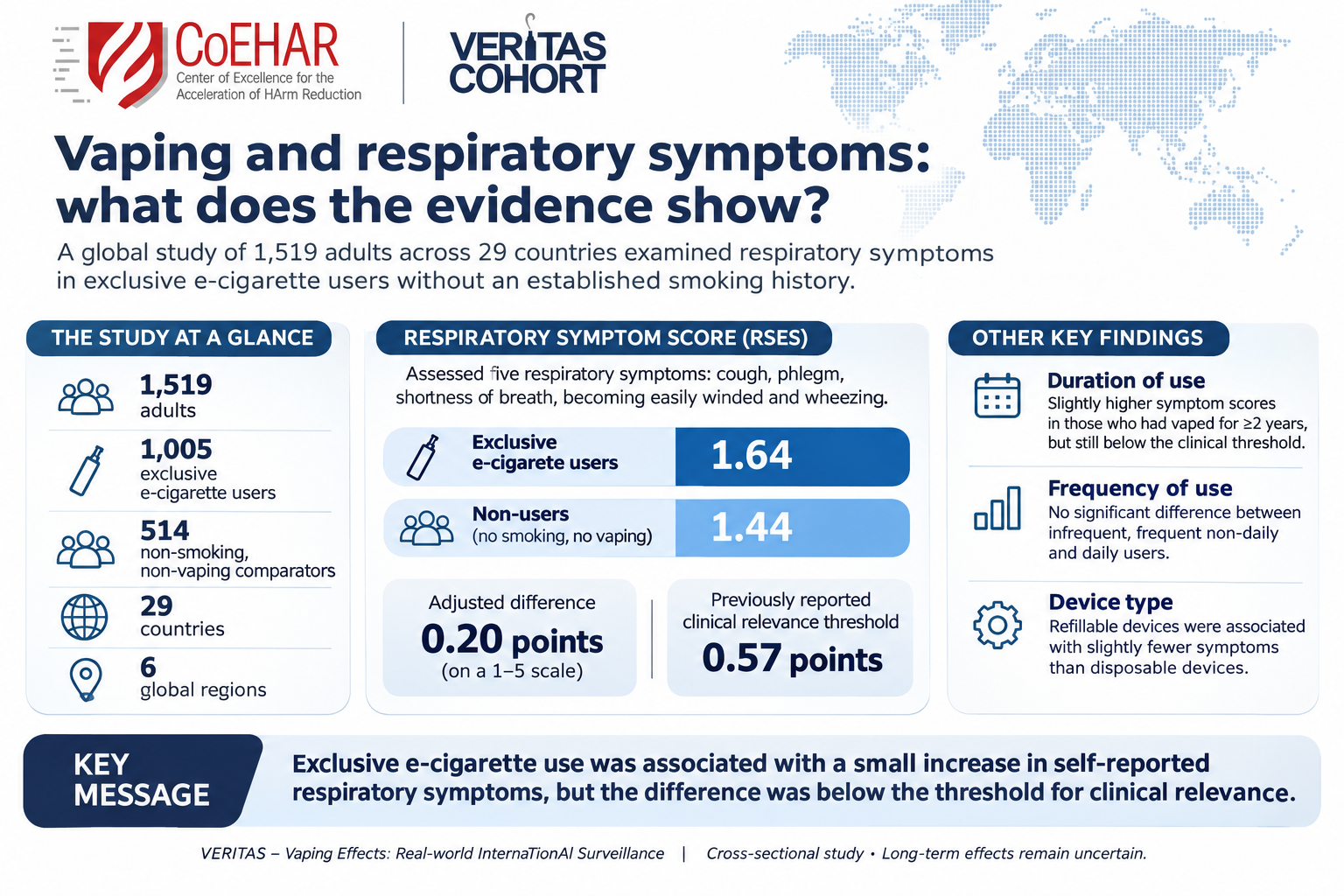
A large international study involving 1,519 adults from 29 countries has found that people who exclusively use e-cigarettes without an established history of cigarette smoking report slightly more frequent respiratory symptoms than non-users. However, the difference was small and remained below a previously reported threshold for clinical relevance.
Published in BMC Pulmonary Medicine, the study is part of the VERITAS (Vaping Effects: Real-world InternaTionAl Surveillance) cohort study, an international research programme coordinated by CoEHAR.
The findings offer new evidence on a question that has long complicated research into vaping and respiratory health: how can researchers distinguish symptoms associated with e-cigarette use from the lasting effects of previous cigarette smoking?
Studying vaping without the confounding effects of established smoking
Many studies investigating the respiratory effects of e-cigarettes include participants who currently smoke or previously smoked conventional cigarettes. This makes it difficult to determine whether observed respiratory symptoms are associated with vaping, previous smoking exposure or a combination of factors. To address this limitation, researchers examined adults from 29 countries across six global regions who had never established a regular cigarette-smoking history. The VERITAS study included 1,005 exclusive e-cigarette users and 514 comparison participants without an established history of smoking or vaping.
Respiratory symptoms were assessed using the validated Respiratory Symptom Experience Scale (RSES), which measures the frequency of symptoms such as cough, phlegm, breathlessness, becoming easily winded and wheezing.
“One of the major problems in studying the health effects of vaping is that most vapers are current or former smokers. This makes it extremely difficult to distinguish the effects of vaping from the legacy effects of cigarette smoking. This study was designed specifically to address that problem,” explained Prof. Riccardo Polosa, senior author of the study at the University of Catania.
A statistically significant difference, but below clinical relevance
Respiratory symptoms were measured using the Respiratory Symptom Experience Scale (RSES), a validated questionnaire that assesses how frequently participants experience five common respiratory symptoms: cough, phlegm, shortness of breath, becoming easily winded and wheezing. The scale ranges from 1 to 5, with lower scores indicating less frequent symptoms. A score of 1 corresponds to symptoms that are never experienced, while higher scores indicate progressively greater symptom frequency.
After accounting for differences in age, sex, body mass index, education and employment status, exclusive e-cigarette users had an average score of 1.64, compared with 1.44 among non-users. In practical terms, both groups reported respiratory symptoms relatively infrequently, with average scores falling between the lowest response categories, “never” and “rarely”.
Although the difference of 0.20 points was statistically significant, it was considerably smaller than the previously reported minimal clinically important difference of 0.57 points — a reference threshold used to identify changes in symptom scores that may be meaningful from a clinical perspective.
In other words, a difference can be statistically significant without necessarily being meaningful in clinical practice. What matters is not only whether a difference can be detected, but also whether it is large enough to have practical implications for patients.
This does not mean that vaping is risk-free, nor does it rule out respiratory effects that may emerge over longer periods of use.
“We did observe a statistically detectable increase in respiratory symptom frequency among exclusive vapers, but the magnitude was small and below the threshold generally considered clinically meaningful. This distinction between statistical significance and clinical significance is crucial,” said Dr Yusuff Adebayo Adebisi, lead author and PhD researcher at the University of Glasgow.
Duration, frequency and device type: what else emerged?
The researchers also explored whether respiratory symptoms differed according to patterns of e-cigarette use. Participants who had vaped for two years or longer reported slightly higher symptom scores than those with a shorter history of use. However, the difference was small and remained below the previously reported threshold for clinical relevance.
By contrast, the analysis found no statistically significant overall differences in symptom scores between infrequent, frequent non-daily and daily users.
Device type was also associated with modest variations: participants using refillable e-cigarettes reported slightly fewer symptoms than those using disposable devices.
These exploratory findings highlight the importance of investigating vaping behaviours in greater detail, while avoiding causal interpretations that cannot be supported by a cross-sectional study.
Why these findings matter for respiratory research
The VERITAS study contributes to a more precise assessment of respiratory symptoms among adults without an established smoking history, a population that remains relatively underrepresented in vaping research. Its international scope and focus on previous smoking exposure are important methodological strengths.
Nevertheless, the findings require careful interpretation. The study relies on self-reported respiratory symptoms and provides a snapshot of participants at a single point in time. It cannot establish whether vaping caused the observed differences or determine the consequences of prolonged exposure.
The absence of a clinically meaningful difference in this symptom score does not establish that vaping is harmless or exclude possible long-term respiratory effects.
Further longitudinal research, including objective measures of respiratory health, will be needed to clarify the clinical implications of these findings.
For CoEHAR, the study reinforces the importance of rigorous research designs, careful assessment of smoking history and the distinction between statistically detectable associations and clinically meaningful outcomes.
Reference
Adebisi YA, Goicoechea JZ, Boughner A, et al. Respiratory symptoms among never-established smokers who vape: a multiregional cross-sectional survey of 1,519 adults. BMC Pulmonary Medicine. Published 3 November 2026. DOI: https://doi.org/10.1186/s12890-026-04943-3
https://link.springer.com/article/10.1186/s12890-026-04943-3