A major international scientific review has found that smokers who switch completely from conventional cigarettes to e-cigarettes experience substantial reductions in exposure to several harmful tobacco- and combustion-related chemicals, with reductions ranging from 61% to 92% across key biomarkers.
Published in Archives of Toxicology, the study systematically reviewed 60 human studies and conducted a biomarker-specific meta-analysis, providing a comprehensive assessment of how exposure to toxic substances changes when cigarette smoking is replaced entirely by vaping.
The research was conducted by an international team including scientists from CoEHAR, alongside toxicology experts from Analytisch-Biologisches Forschungslabor (ABF) in Munich, Germany.
The findings contribute important evidence to the scientific discussion on tobacco harm reduction, highlighting the role of eliminating cigarette combustion in reducing exposure to harmful substances.
Measuring what happens inside the body
One of the most important aspects of this review is its focus on human biomarkers of exposure, rather than laboratory measurements of chemical emissions alone. Biomarkers are measurable substances or biological indicators found in samples such as blood, urine or exhaled breath. They allow researchers to assess the extent to which individuals have actually been exposed to specific chemicals.
By examining these measurements across multiple studies, the researchers investigated how exposure to harmful substances changes after smokers stop using conventional cigarettes and switch completely to e-cigarettes.
The analysis focused on biomarkers associated with tobacco-specific carcinogens, volatile organic compounds and products of combustion.
“These are not theoretical estimates based on laboratory emissions. They are measurements of toxicant exposure inside the body of real people,” said Dr Yusuff Adebayo Adebisi, lead author of the study. “The findings demonstrate that eliminating cigarette combustion can dramatically reduce exposure to many of the toxic chemicals associated with smoking.”
Substantial reductions across key biomarkers
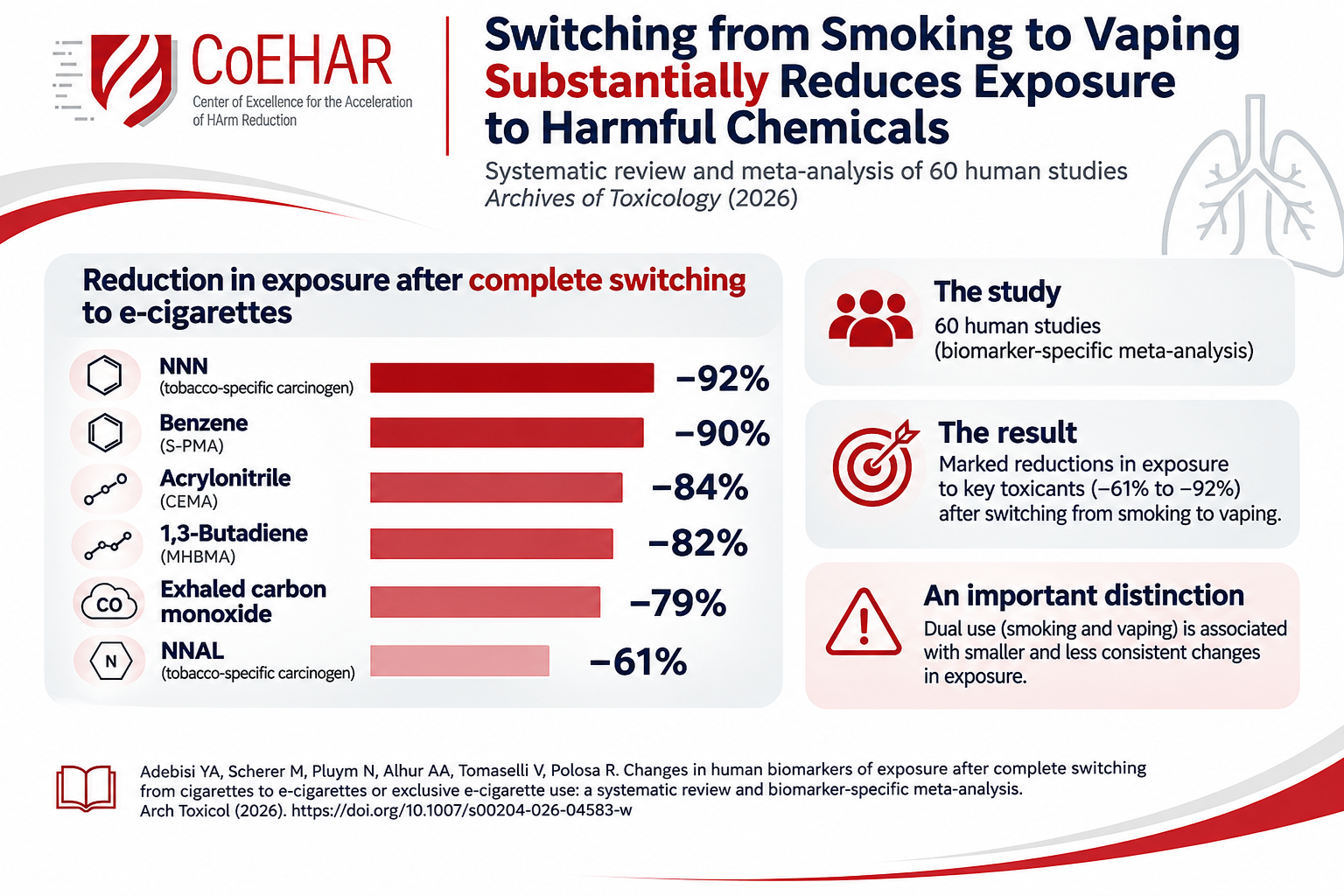
The meta-analysis identified marked reductions in several important biomarkers of toxicant exposure following complete switching from cigarettes to e-cigarettes. Among the most notable findings:
- 92% lower NNN, a tobacco-specific carcinogenic compound.
- 90% lower exposure to benzene, assessed through its urinary metabolite S-PMA.
- 84% lower exposure to acrylonitrile, measured through the biomarker CEMA.
- 82% lower exposure to 1,3-butadiene, assessed through MHBMA.
- 79% lower exhaled carbon monoxide, a key indicator of exposure to cigarette combustion.
- 61% lower NNAL, a biomarker associated with exposure to a tobacco-specific carcinogen.
All ten biomarkers included in the quantitative meta-analysis showed reductions in exposure.
These results indicate that replacing combustible cigarettes entirely with e-cigarettes can substantially reduce exposure to several toxic substances associated with smoking.
However, reductions in exposure should not be interpreted as equivalent reductions in disease risk. Biomarkers provide important information about chemical exposure, but further research is needed to establish how these changes influence long-term health outcomes.
Complete switching and dual use: an essential distinction
A particularly important finding concerns the difference between completely replacing cigarettes with e-cigarettes and continuing to smoke while also vaping. The review found that people who used both products generally experienced smaller and less consistent reductions in toxicant exposure compared with those who switched completely. This distinction is particularly relevant for interpreting studies on the potential benefits of tobacco harm reduction.
While switching entirely to non-combustible products eliminates exposure from continued cigarette smoking, dual users remain exposed to the harmful substances generated by tobacco combustion.
The findings therefore reinforce the importance of distinguishing complete substitution from dual use when assessing changes in toxicant exposure.
Why these findings matter for tobacco harm reduction
Cigarette smoke contains numerous harmful chemicals produced or released during tobacco combustion, including substances associated with cancer, cardiovascular disease and respiratory illness. Reducing exposure to these compounds is an important objective of tobacco harm reduction research, particularly for adults who smoke and do not otherwise stop using nicotine.
The review strengthens the available human evidence by bringing together results from multiple studies and examining individual biomarkers through quantitative analysis. Its findings support the conclusion that complete substitution of conventional cigarettes with e-cigarettes is associated with substantial reductions in exposure to several harmful chemicals.
At the same time, the authors emphasise the need to distinguish between reduced exposure and demonstrated improvements in long-term health.
“The public-health message is straightforward,” explained Prof. Riccardo Polosa, senior author of the study. “Combustion is a major source of toxic exposure. When smokers eliminate cigarettes completely, exposure to many important toxicants falls sharply. The next challenge is establishing how these changes translate into long-term health outcomes.”
From reduced exposure to long-term health outcomes
The findings provide a clearer understanding of the biological changes associated with complete switching from smoking to vaping. By focusing on biomarkers measured directly in humans, the review offers evidence that complements laboratory toxicology and clinical research.
Nevertheless, the long-term implications of these reductions require continued investigation. Lower exposure to harmful chemicals is a relevant indicator, but it does not establish that e-cigarette use is risk-free or quantify the reduction in future disease risk. Further longitudinal studies will be essential to determine how sustained reductions in toxicant exposure translate into respiratory, cardiovascular and other health outcomes.
For CoEHAR, the study represents an important contribution to the evidence base on tobacco harm reduction and reinforces the need for rigorous research that distinguishes chemical exposure, biological effects and long-term clinical outcomes.
Reference
Adebisi YA, Scherer M, Pluym N, Alhur AA, Tomaselli V, Polosa R. Changes in human biomarkers of exposure after complete switching from cigarettes to e-cigarettes or exclusive e-cigarette use: a systematic review and biomarker-specific meta-analysis. Archives of Toxicology (2026). DOI: https://doi.org/10.1007/s00204-026-04583-w
https://link.springer.com/article/10.1007/s00204-026-04583-w