
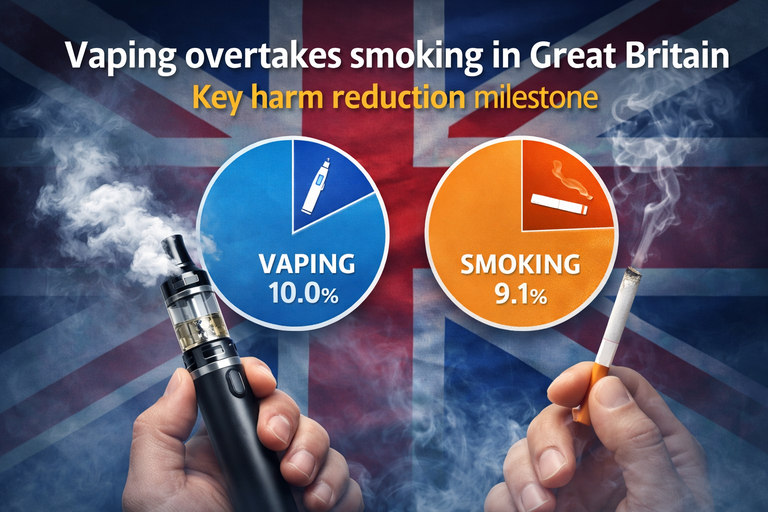
For the first time since national records began, e-cigarette use has surpassed cigarette smoking in Great Britain. This milestone, highlighted in a new CoEHAR commentary published in the International Journal of Public Health, marks a significant shift in patterns of nicotine use — and offers important insights for tobacco control strategies.
According to recent national estimates, 10.0% of adults reported using e-cigarettes in 2024, compared with 9.1% who smoked tobacco cigarettes. At the same time, smoking prevalence in the UK has declined dramatically over the past decade, falling from 20.2% in 2011 to 10.6% in 2024 among adults.
Rather than representing a new public health concern, this crossover appears to reflect a broader transition away from combustible tobacco.
Crucially, vaping in Great Britain remains overwhelmingly concentrated among individuals with a history of smoking.
Among e-cigarette users:
- 55% are former smokers
- 40% are dual users
- Only around 5% have never smoked
This distribution suggests that vaping is functioning primarily as a substitute for smoking, rather than a widespread entry point into nicotine use among never-smokers.
The commentary also points to a growing body of evidence showing that complete switching from cigarettes to e-cigarettes is associated with substantial reductions in exposure to tobacco toxicants.
While dual use remains common, it may often represent a transitional phase rather than a stable pattern — particularly among individuals attempting to move away from combustible tobacco.
A policy signal: balance matters
The UK experience highlights the importance of proportionate regulation. Policies that protect youth from nicotine uptake remain essential. At the same time, maintaining access to lower-risk alternatives for adults who smoke may play a key role in accelerating declines in smoking prevalence.
As highlighted by Prof. Riccardo Polosa, co-author of the commentary and founder of CoEHAR:
“This is a historic shift. Seeing vaping overtake smoking at a population level suggests that many smokers are moving away from combustible tobacco. The key challenge now is to ensure that policies continue to protect young people while not restricting access to less harmful alternatives for adults who smoke.”
Taken together, these findings position Great Britain as a real-world case study of how shifts in product use — from combustible to non-combustible nicotine — can coincide with substantial declines in smoking.
The challenge for policymakers is to interpret this transition correctly: not as a replacement of one problem with another, but as a potential pathway toward reducing the burden of smoking-related disease.
About the commentary
Adebisi YA, Polosa R, George J.
Harm Reduction Implications of Vaping Overtaking Smoking in Great Britain.
International Journal of Public Health. 2026; 71:1609671.
DOI: 10.3389/ijph.2026.1609671