
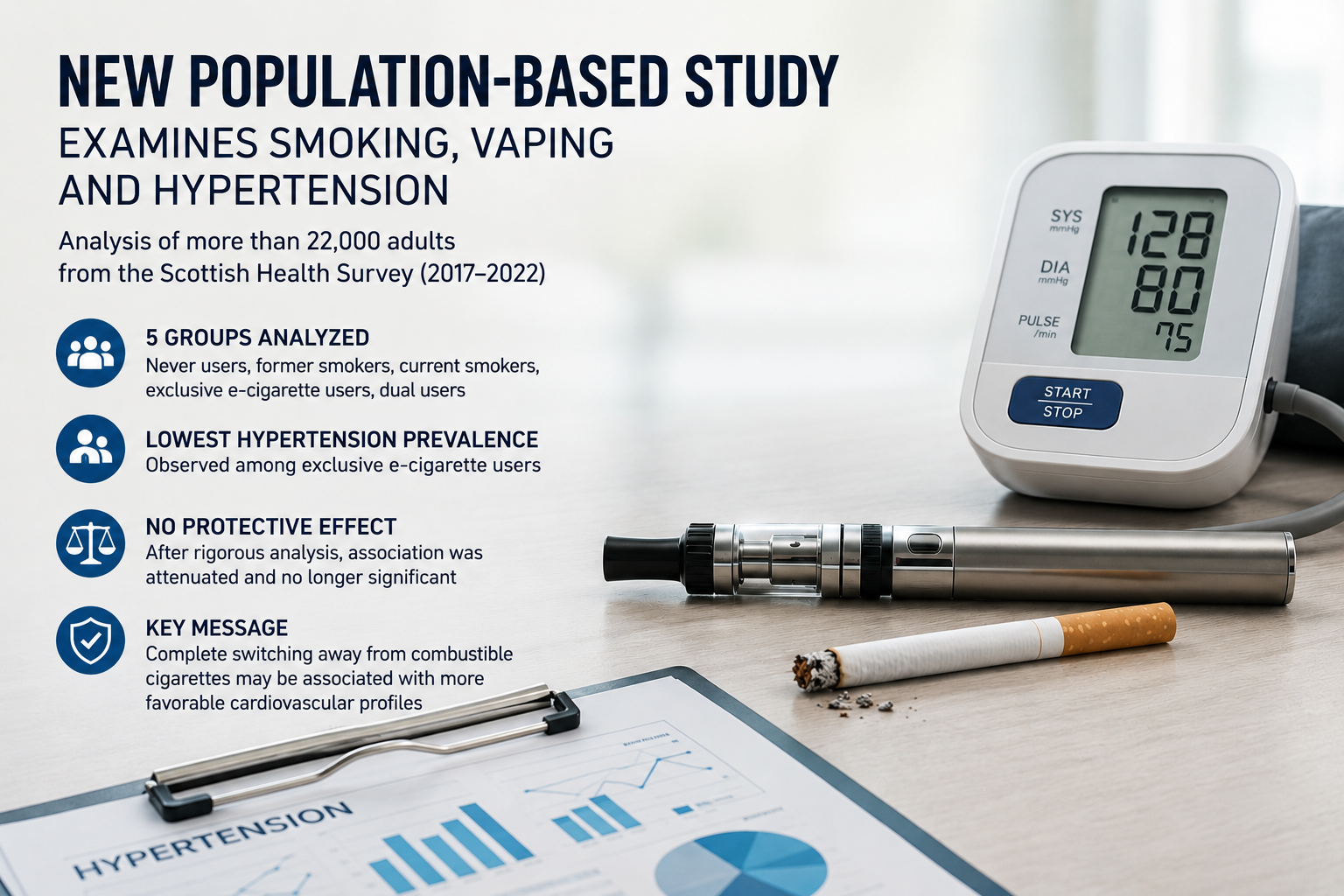
A new study published in the Journal of Human Hypertension (Nature Group) has investigated the association between cigarette smoking, e-cigarette use, and doctor-diagnosed hypertension among more than 22,000 adults in Scotland.
Conducted by several CoEHAR researchers, the study analyzed pooled data from the Scottish Health Survey (2017–2022) to examine how different patterns of nicotine use relate to hypertension prevalence in the general population. Participants were classified into five groups: never users, former smokers, current cigarette smokers, current exclusive e-cigarette users, and dual users of cigarettes and e-cigarettes.
The researchers found that the prevalence of doctor-diagnosed hypertension was lowest among current exclusive e-cigarette users and highest among former smokers.
In conventional adjusted analyses, exclusive e-cigarette use was associated with lower odds of hypertension compared with never use. However, when the researchers applied propensity-score matching—a statistical technique designed to reduce differences between groups—the association was substantially attenuated and no longer statistically significant.
These findings suggest that the observed relationship may be influenced by differences in participant characteristics rather than by e-cigarette use itself.
The Importance of Interpreting Observational Data Carefully
The authors emphasize that the results should not be interpreted as evidence that vaping protects against hypertension.
Instead, the lower prevalence observed among exclusive e-cigarette users may reflect factors such as age, body weight, lifestyle characteristics, prior smoking history, healthcare engagement, or other residual confounding variables. The study also highlights the possibility of a “healthy switcher” effect, whereby smokers who successfully transition away from combustible cigarettes may differ systematically from those who continue smoking.
Importantly, dual users—individuals who both smoked cigarettes and used e-cigarettes—did not exhibit lower odds of hypertension. This finding reinforces the notion that any potential cardiovascular advantage is more likely linked to complete displacement of combustible cigarette smoking rather than the use of e-cigarettes alone.
Implications for Tobacco Harm Reduction Research
While smoking remains one of the most important modifiable cardiovascular risk factors worldwide, the relationship between smoking status and hypertension is often complex and difficult to evaluate using cross-sectional population studies.
The authors note that their findings align with a cautious tobacco harm reduction perspective. E-cigarettes should not be described as protective against hypertension, but complete switching away from combustible cigarettes may be associated with more favorable cardiovascular profiles than continued smoking.
“The key message of this study is not that vaping lowers blood pressure, but that the cardiovascular consequences of smoking and nicotine use are more complex than often portrayed,” said Prof. Riccardo Polosa, CoEHAR Founder and author of the study. “From a public health perspective, moving smokers away from combustion remains the primary objective.”
Further longitudinal and mechanistic studies will be needed to better understand the long-term cardiovascular implications of switching from combustible cigarettes to smoke-free alternatives.
Reference
Adebisi YA, Volpe M, George J, Shukri AK, Alshahrani NZ, Capodanno D, Almustafa BA, Polosa R.
Smoking, vaping and hypertension: findings from a population-based cross-sectional study in Scotland.
Journal of Human Hypertension (2026).
doi: 10.1038/s41371-026-01171-4