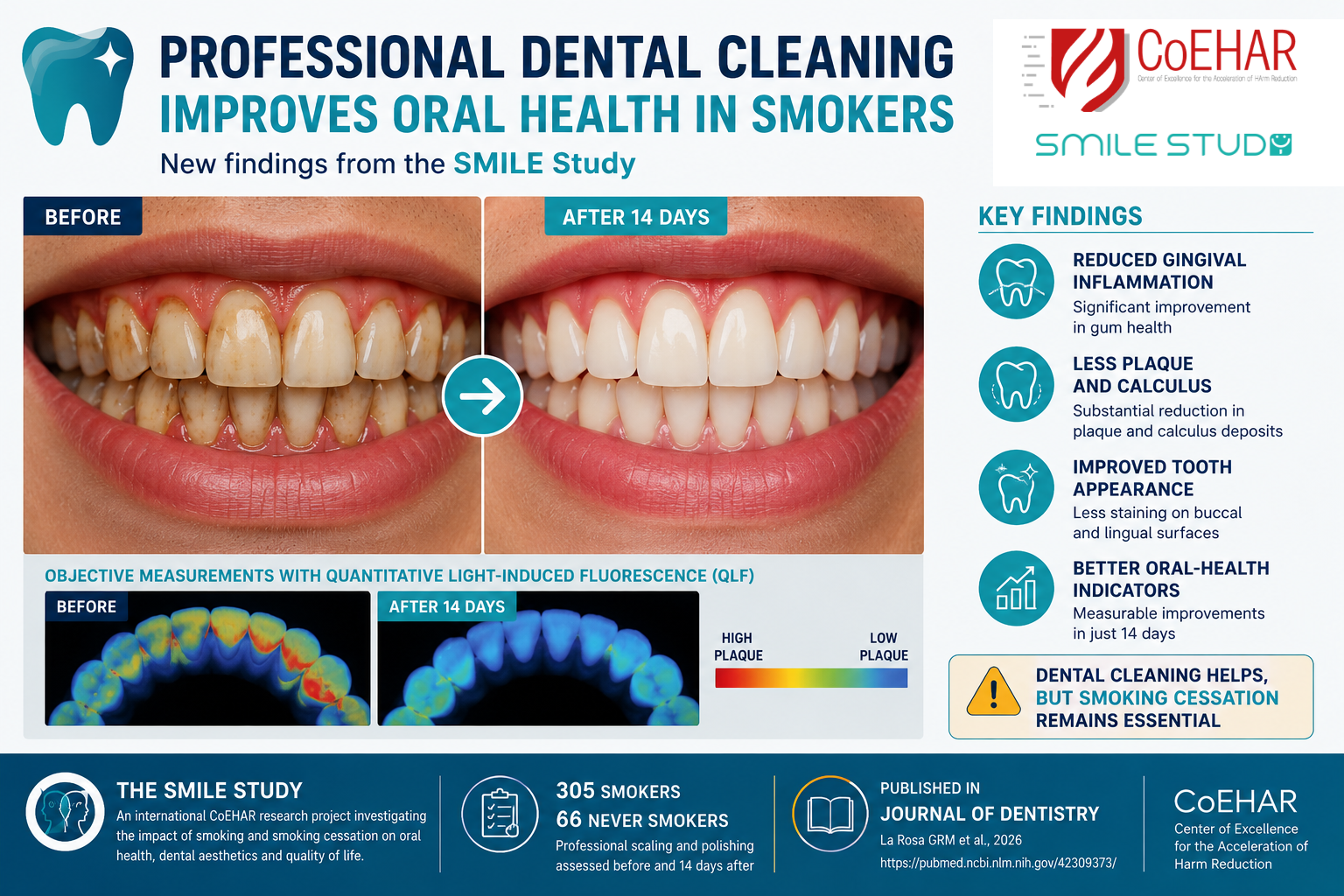
A new analysis from the SMILE Study cohort, published in the Journal of Dentistry, has shown that professional dental cleaning can produce rapid and measurable improvements in oral health among smokers, even when smoking continues.
The research analyzed the effects of professional scaling and polishing in 305 current smokers and 66 never smokers, assessing participants before treatment and again 14 days later. Researchers evaluated a range of oral-health and dental-aesthetic outcomes, including gingival inflammation, plaque accumulation, calculus deposits, tooth staining, tooth whiteness, oral hygiene scores, oral-health-related quality of life, and self-perceived general health.
Smokers Started with a Higher Oral-Health Burden
At baseline, smokers consistently showed poorer oral-health indicators than never smokers. They exhibited higher levels of gingival inflammation, greater plaque and calculus accumulation, more pronounced tooth staining, and lower tooth whiteness scores. These findings are consistent with the well-established impact of cigarette smoking on oral tissues and dental aesthetics.
The study also employed quantitative light-induced fluorescence (QLF) technology, an objective imaging method capable of detecting and quantifying dental plaque and tooth discoloration with high precision.
Significant Improvements After Professional Cleaning
Following professional scaling and polishing, both smokers and never smokers experienced significant improvements across several clinical and instrumental oral-health measures.
However, smokers demonstrated the largest short-term gains in gingival inflammation, buccal and lingual tooth staining, and plaque/calculus accumulation. According to the researchers, this reflects the higher oral-health burden present before treatment and the greater potential for improvement following professional plaque removal.
The findings show that professional dental cleaning can rapidly improve both oral-health indicators and dental appearance, even among individuals who continue smoking.
Supporting Oral Health While Encouraging Smoking Cessation
The authors emphasize that professional plaque removal should not be viewed as an alternative to smoking cessation. While scaling and polishing can help mitigate some of the oral-health and aesthetic consequences associated with smoking, tobacco smoke remains a major risk factor for periodontal disease, tooth discoloration, and other oral conditions. Regular professional dental care therefore represents an important complementary strategy for smokers, alongside evidence-based smoking cessation support.
One of the strengths of the study was the use of objective imaging technologies capable of visualizing changes that may not be immediately apparent to patients. The authors suggest that tools such as QLF could play an important role not only in monitoring oral health but also in improving patient awareness and motivation by providing visible evidence of treatment outcomes.
“Smokers often carry a hidden oral-health burden that may not be fully appreciated until measured objectively,” said Dr. Giusy La Rosa, lead author of the study. “This study shows that professional plaque removal can generate rapid, clinically meaningful improvements—but also reminds us that sustained oral-health protection ultimately depends on eliminating tobacco smoke exposure.”
The findings reinforce the importance of regular professional dental care for smokers and support the integration of objective oral-health assessments into routine clinical practice. At the same time, the study highlights a key public-health message: while dental cleaning can substantially improve oral-health indicators and dental aesthetics, quitting smoking remains the most effective strategy for long-term protection of oral and periodontal health.
The SMILE Study: Advancing Research on Smoking and Oral Health
The present analysis is part of the SMILE Study, an international CoEHAR research project designed to investigate the long-term effects of smoking and smoking cessation on oral health. Since its inception, the SMILE Study has generated important evidence on the relationship between tobacco use, combustion-free alternatives, oral-health outcomes, and quality of life. By combining clinical assessments with innovative technologies such as quantitative light-induced fluorescence (QLF), the project aims to improve understanding of how different smoking behaviors influence oral health over time. The current findings further reinforce the importance of preventive dental care and provide new evidence on the potential benefits of professional oral-hygiene interventions among smokers.
Reference
La Rosa GRM, Kowalski J, Isola G, Cibella F, Urso S, Tomaino E, Polosa R; SMILE Study Working Group. Impact of professional scaling and polishing on oral health indicators in smokers and never smokers: a prospective analysis from the SMILE Study cohort. Journal of Dentistry (2026).
https://www.sciencedirect.com/science/article/pii/S0300571226005099?via%3Dihub