Collegium Internationale Diabetologicum – Catania, 10–11 November 202
The first-of-its-kind DELPHI Consensus Meeting of the Collegium Internationale Diabetologicum will convene leading experts to tackle current challenges and innovations in diabetology, spanning research, methodology, and clinical practice.
The program combines public scientific symposia, closed-door methodology sessions, and consensus panels led by specialist methodologists. The central focus is the application of the Delphi method to smoking cessation and harm reduction in people with type 2 diabetes, with the goal of producing clear, implementable guidance.
Hosted in Catania, Sicily (Italy) on 10–11 November 2025, the meeting is organized under the PNRR HEAL Italia research program, funded by the European Union and the Italian Ministry of University and Research in collaboration with the Center of Excellence for Acceleration of HArm Reduction (CoEHAR), at the University of Catania, Italy.
Why it matters
The Collegium will convene leading voices in diabetology, cardiovascular medicine, public health, and harm reduction to develop a shared, evidence-informed position on how best to support people with T2D who smoke, aiming for practical guidance that can translate into better clinical pathways and public-health policy.
What is the Delphi approach?
Delphi is a structured, iterative process that harmonizes expert opinion to reach consensus on complex questions, ideal when evidence is evolving and implementation choices must be clear and actionable.
Format & goals
The Delphi Consensus Meeting aims to secure an evidence-informed, international consensus on the role of prevention, cessation, and harm reduction in people with type 2 diabetes; identify critical evidence gaps and research priorities; and translate findings into concise, practical guidance for diabetes services. The expert panel will define minimum standards for screening, brief interventions, safe pharmacological/behavioral strategies, and early post-quit monitoring (glucose, BP, weight). Outputs will also address health-system enablers (training, reimbursement, digital follow-up, and equity) culminating in a peer-reviewed international consensus statement with graded recommendations and clear implementation priorities.
Leadership & participation
The discussions will be chaired by Prof. Riccardo Polosa (Professor of Internal Medicine and CoEHAR Founder; University of Catania) and led by DELPHI methodologist Dr. Alessandro Urbani (AIM Group International). A closed-door Delphi session (in-person and via livestream) will gather 36 international experts from universities and research centers worldwide, including:
Yusuff Adebisi (UK), Bader Almustafa (Saudi Arabia), Abdul Basit (Pakistan), Tadej Battelino (Slovenia), Raffaella Buzzetti (Italy), Rossella Cannarella (Italy), Giulio Cantone (Italy), Valentino Cherubini (Italy), Roger Chen (Australia), Konstantinos Farsalinos (Greece), Jacob George (UK), Mohamed Hassanein (United Arab Emirates), Muhammad Yazid Jalaludin (Malaysia), Linong Ji (China), Jackie Kassouf (Lebanon), Giusy La Rosa (Italy), Yong-Ho Lee, (South Korea), Lee-Ling Lim (Malaysia), Ronald Ma (Hong Kong), Dianna Magliano (Australia), Alison Martin (UK), Bien Matawaran (Philippines), Anoop Misra (India), Joanna Mitri (USA), Othmar Moser (Netherlands), Aliya Naheed (Bangladesh), Andrew Reynolds (New Zealand), Yoshifumi Saisho (Japan), Giorgio Sesti (Italy), Pankaj Sharma (UK), Apostolos Tsapas (Greece), Vijay Viswanathan (India), Massimo Volpe (Italy), and Magda Walicka (Poland).
Background & Context
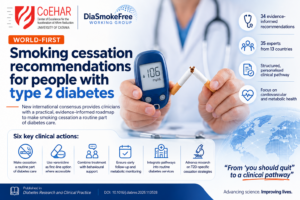
This Collegium builds on the work of the DiaSmokeFree Working Group, which recently developed the Guidelines for Smoking Cessation in Type 2 Diabetes.
According to this document, people with type 2 diabetes who smoke face an increased risk of vascular diseases, poor glycemic control, complications, and premature death. The guidelines offer practical steps to embed cessation into diabetes care while addressing psychological and organizational barriers. Because smoking cessation can alter the metabolism of certain medications, the guidelines recommend close monitoring of blood glucose, blood pressure, and body weight in the first weeks after cessation. Emerging strategies, non-combustion nicotine options, apps, wearables, and remote monitoring, that extend support beyond clinic visits were also discussed.
For updates and the forthcoming consensus statement, follow CoEHAR channels